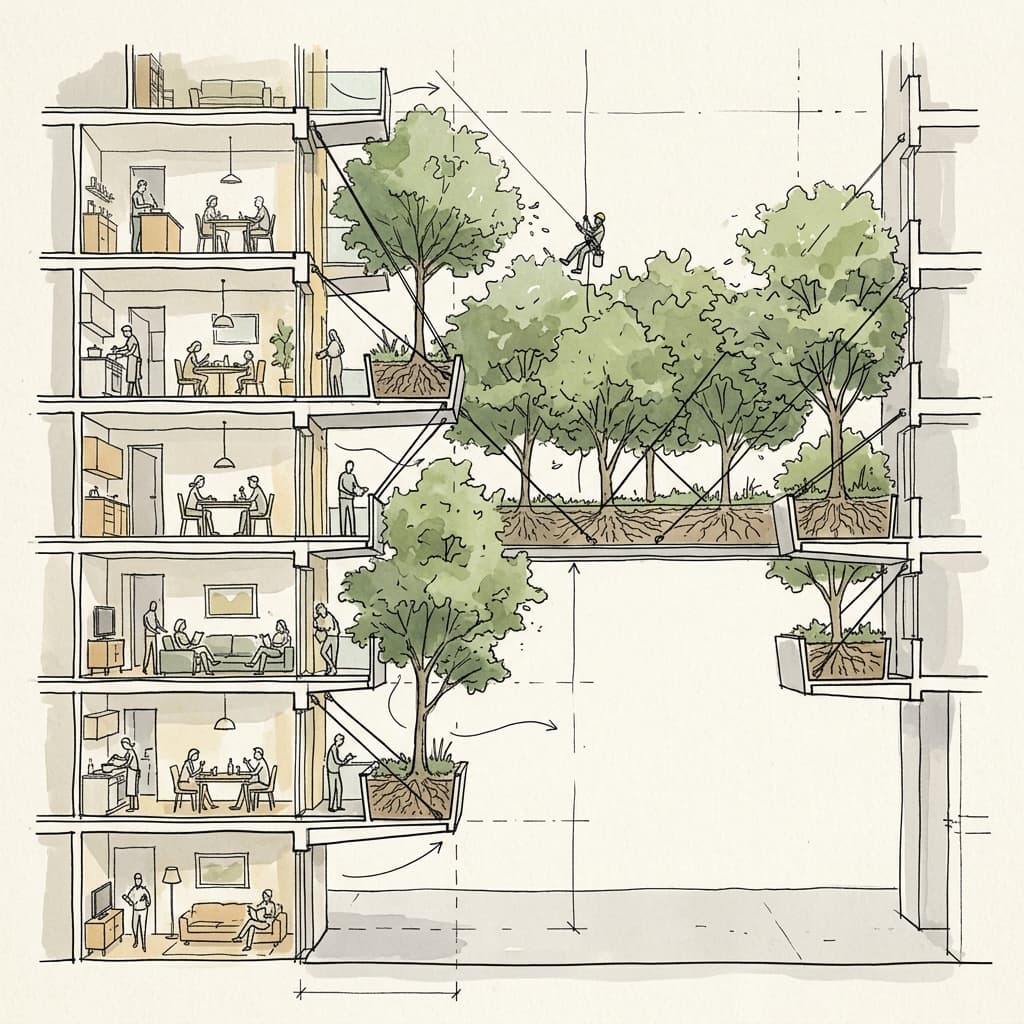
In Milan, 800 trees have lived on the balconies of two residential towers since 2014. They owe it as much to the arborists’ ropes and the building’s rules as to its structural design.
Twice a year, arborists abseil down the façades of Bosco Verticale to prune the trees from the outside. The two residential towers, designed by Boeri Studio (Stefano Boeri, Gianandrea Barreca and Giovanni La Varra) in Milan’s Porta Nuova district, carry some 800 trees and 4,500 shrubs. Planting went ahead in stages from 2012 to 2014, the year the building was completed.
What stands out is the organisation as much as the structure. Before construction, the wind was tested on a model in the Politecnico di Milano’s wind tunnel, then at full scale in a laboratory in Florida. The most exposed trees, roughly one in fifteen, were given an extra anchoring system. Above all, the planted areas of the balconies are not sold with the flats: upkeep is managed in common, and no owner can change its rules. Every tree therefore has a way in, a schedule and someone who answers for it.
Any planting placed on a building raises the same question: how will anyone reach it in ten years’ time? Wisteria on a school façade needs a cherry picker or a walkway for pruning. A planted roof on a town hall needs safe access and a line in the running budget. An upstairs planter on a house needs a tap within reach. These things are drawn at the same time as the planter. Added later, they cost a great deal, and it is often the plant that ends up being removed.
Then there is the price. In 2013, before completion, the journalist Tim De Chant calculated that the money spent on the towers’ trees could have restored at least 860 times as much forest on the ground. The calculation can be argued with. The question stands: what does this upkeep cost each year, and what does it give back to birds, insects and the coolness of the neighbourhood? We have found no published figures.
What we take away
- Wind tested in a tunnel and then at full scale, with extra anchoring for the most exposed trees.
- Planted areas managed in common, whose upkeep no owner can change.
- Arborists on ropes twice a year: reaching the trees is part of how the building runs.
What leaves us wondering
- The annual cost of upkeep, at the heart of the best-known criticism of the project, has no published figure as far as we know.
- No recent study found on the birds and insects that use the towers; the most cited field study of the planting dates from 2013-2014.
This project is the work of Boeri Studio. The analytical sketch is by LIBER.ARCHI; original photographs and documents belong to their authors and are best discovered at the source.
View the project : Stefano Boeri Architetti : page du projetLIBER.ARCHI analytical sketch: our reading of the project, not a reproduction.
Guillaume Ciletti
Licensed Architect (HMONP) - Founder of LIBER.ARCHI