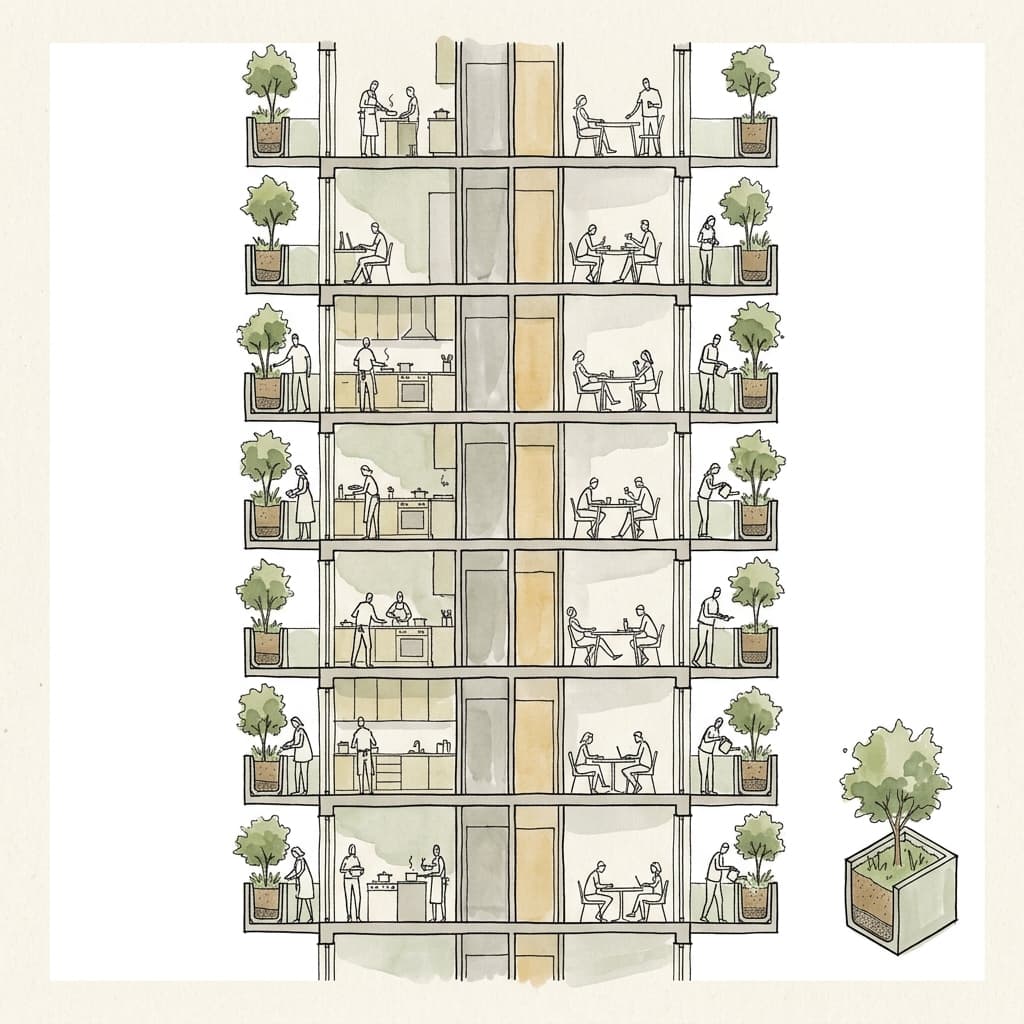
In Eindhoven, a social housing tower gives every flat a tree on its terrace. The money for the trees was found in the rest of the building, which was kept deliberately ordinary.
€620 a month: that was the rent for a flat in Trudo Vertical Forest, in Eindhoven, when it opened in 2021. The nineteen-storey tower, designed by Stefano Boeri Architetti for the social landlord Sint Trudo, stands on Strijp-S, Philips’s former industrial site. Its 125 homes are under 50 m² each, and every one has a terrace of more than 4 m² with a tree and around twenty shrubs. In all, 135 trees and some 5,200 shrubs and plants of more than seventy species, watered with rainwater from four 20,000-litre tanks.
Its architects present it as the first vertical forest built for social housing. According to Domus, costs were held at €1,200 per square metre through unglamorous choices: precast concrete, a façade system already proven elsewhere, shallower balconies, plain interior finishes. The savings came out of the building itself, and the trees stayed in.
A school or a town hall can make the same trade-off. When money is short, the temptation is to keep the showpiece façade and cut the planting down to a few containers. Trudo shows the opposite order: a plain, well-built building, and trees where people actually live. For a house, that might mean a plan without needless setbacks, and a proper planting pit rather than expensive cladding.
The tower opened in October 2021, and five years is when a first assessment is due. We have not found one published. How many trees have had to be replaced? And does their upkeep, entrusted to specialists according to Domus, weigh on the rents? The worth of the example rests on those two answers.
What we take away
- A tree and around twenty shrubs on every flat’s terrace, at a social rent.
- Costs held at €1,200 per square metre by simplifying the structure and finishes; the trees stayed.
- Irrigation with rainwater, stored in four 20,000-litre tanks.
What leaves us wondering
- No published five-year assessment found: how many trees were replaced, and what the upkeep costs, remain unknown.
- Trees in containers, with no contact with the ground: the question of open soil is still untouched.
This project is the work of Stefano Boeri Architetti. The analytical sketch is by LIBER.ARCHI; original photographs and documents belong to their authors and are best discovered at the source.
View the project : Stefano Boeri Architetti : page du projetLIBER.ARCHI analytical sketch: our reading of the project, not a reproduction.
Guillaume Ciletti
Licensed Architect (HMONP) - Founder of LIBER.ARCHI