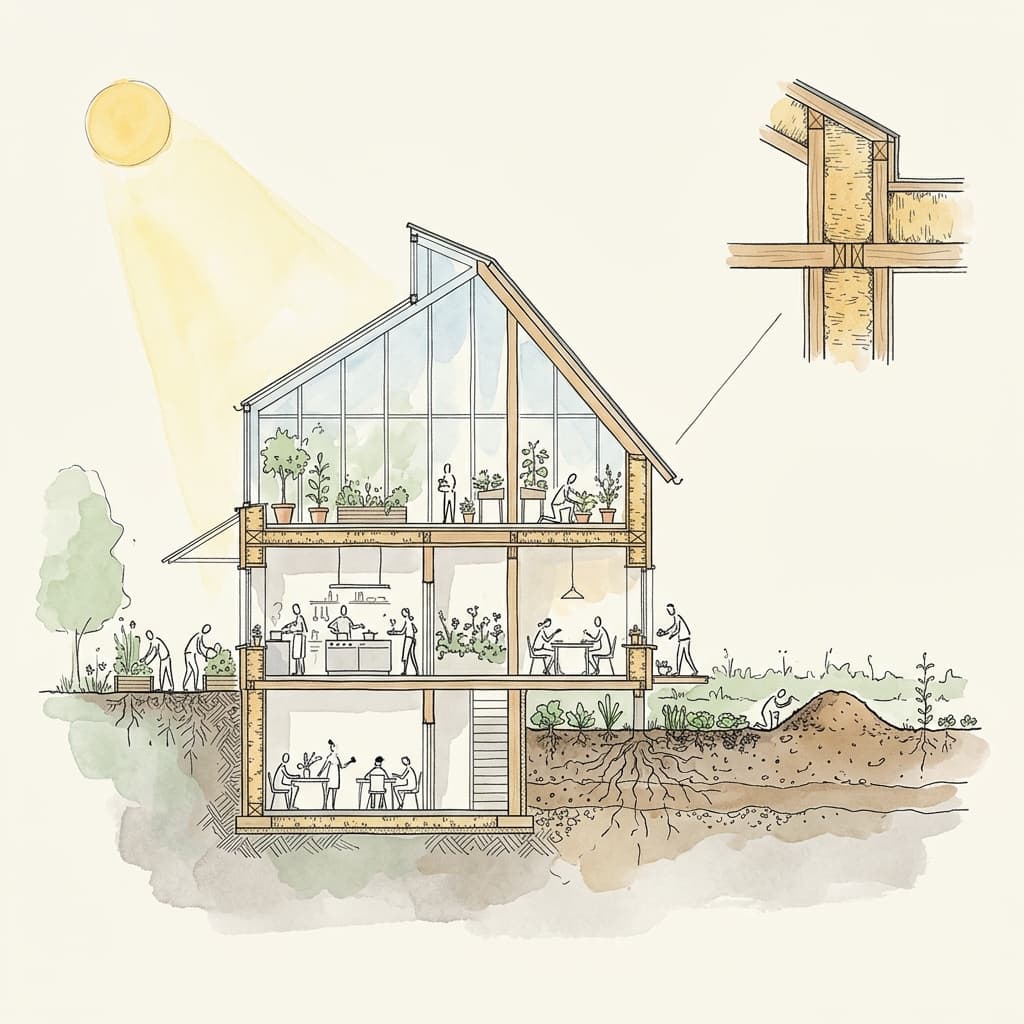
Along the Petite Ceinture, Paris’s old rail belt, La Ferme du Rail houses and trains people rebuilding their working lives around a vegetable garden in open ground. Its building works for that soil: it brings it water, matter and gardeners.
At the foot of the Petite Ceinture viaduct, on rue de l’Ourcq in Paris’s 19th arrondissement, La Ferme du Rail is an urban farm: a vegetable garden at the heart of the plot, fruit trees and herbs on the embankment, a greenhouse, a restaurant and a grocery. The timber building, insulated with straw, houses people in social reintegration and horticulture students, who work the land they live on. Designed by Grand Huit, the project won the “Réinventer Paris” call in 2016 and was completed in 2019.
The building works for the ground around it. Rain falling on the roofs is collected in a pond and used to water the crops. Food waste from the neighbourhood is collected and recovered there. And the people who live on the site are the ones who farm it. Water, matter and hands all pass through the building before reaching the soil.
None of this needs a farm to apply. A house, a school or a town hall can also be drawn starting from the ground it stands on: keeping open ground at the heart of the plot rather than in its leftovers, sending roof water to the garden rather than the sewer, setting aside room for compost in the plan. These are drawing decisions. They are easy to take at the start and hard to catch up on at the end.
Two questions remain that we would love to see documented. What biodiversity does the place actually host, measured beyond food production? And how does such dense planting, in the middle of a city, keep pests at bay? A credible project must also say what it does not intend to host.
What we take away
- A building that serves its soil: roof water irrigates the crops, neighbourhood food waste is recovered.
- Real open-ground growing at the heart of the plot, where so many projects settle for planters.
- Residents who farm the land they live on: the garden has its gardeners on site.
- Careful bioclimatic architecture for a job-training place: timber, straw, reuse, wood-fired heating.
What leaves us wondering
- No quantified ecological monitoring found in open sources: the biodiversity actually hosted remains to be measured, beyond food production.
- How dense urban planting protects itself from pests and damp is scarcely documented, yet that is where the neighbours’ acceptance is won.
This project is the work of Grand Huit. The analytical sketch is by LIBER.ARCHI; original photographs and documents belong to their authors and are best discovered at the source.
View the project : Grand Huit : page du projetLIBER.ARCHI analytical sketch: our reading of the project, not a reproduction.
Guillaume Ciletti
Licensed Architect (HMONP) - Founder of LIBER.ARCHI