In high summer, asphalt burns underfoot and every child crowds into the one patch of shade going. Under that sterile crust, a whole soil is waiting to drink the rain and cool the air again. Here is how to let it happen.
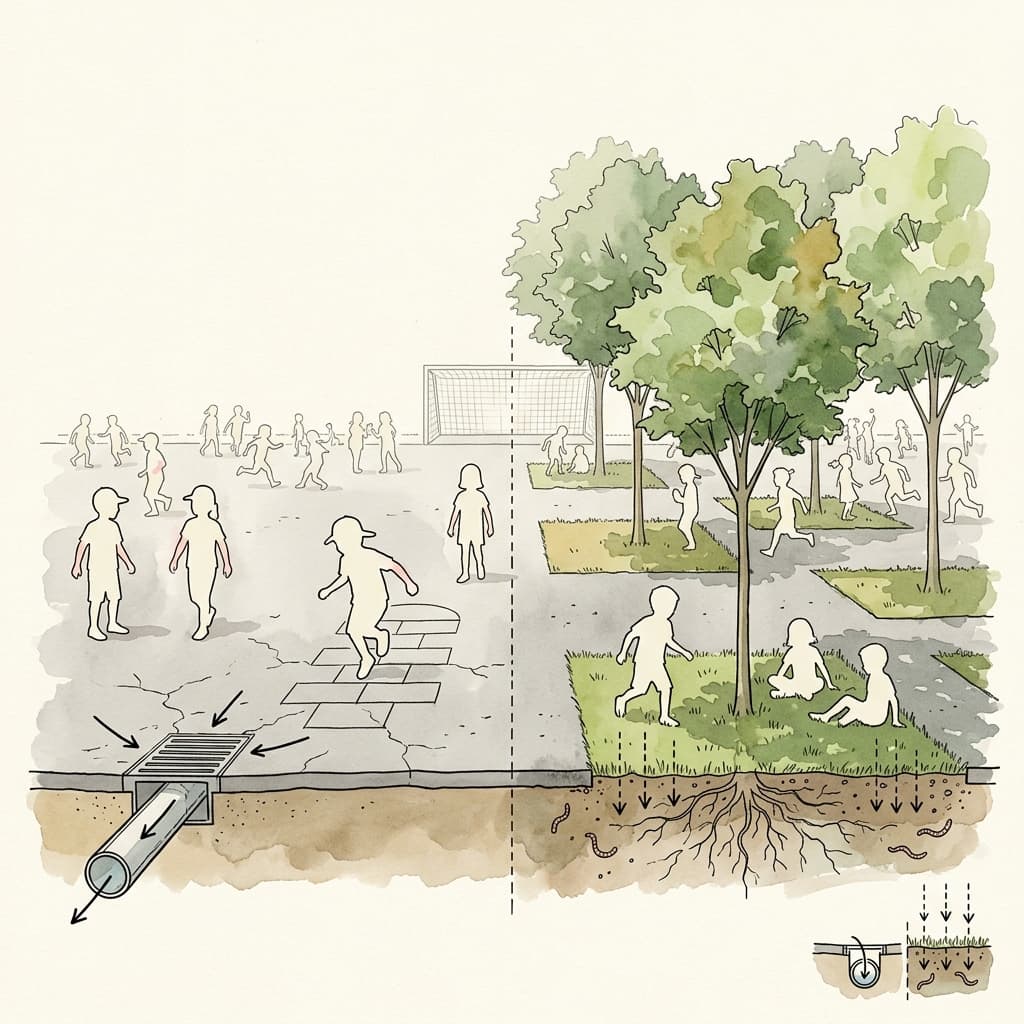
Why unseal a school playground? Because a square metre of living ground does things a square metre of asphalt cannot: it drinks the rain instead of sending it toward drains that are already struggling, and it holds far less heat, when the storm hits and when the heatwave comes. The remedy is simple to state: strip out the asphalt where it serves no purpose, plant shade trees, let the water sink in. The ground then turns back into the sponge and the cooling system of the place, as we wrote in “Soil first”.
For the children, the gain is felt first in summer. Under mature trees, on ground that holds its coolness instead of handing heat back like an oven, hours of playtime are given back on the hottest days, when bare asphalt turns hostile and the shadow of a covered walkway is no longer enough. You could provide shade some other way: an awning, a shade sail, a classroom air conditioner. All of that gets installed, serviced, replaced. A tree planted in the right spot needs a few years of care, then does the work, season after season. It grows up alongside the children.
That is the wager we made near Chambéry, in the French Alps, together with POESAGES: three trees and some 300 m² of lawn in place of asphalt, completed in 2024. Under the asphalt, a soil had been waiting decades to breathe again. Where the asphalt did nothing but store heat, we took it out, then planted shade trees. Rainwater now reaches the ground directly, instead of running off toward a drain. Three trees and a soil given back to the rain is little, but the water sinks in from today; the shade will come with the years. It took very little to make a start.
Unsealing school playgrounds is a movement far larger than our own project. The City of Paris adopted its resilience strategy in September 2017. Since then it has been methodically transforming its school playgrounds: 203 oasis playgrounds and 5 oasis crèches according to the City, as of January 2025. Its Climate Plan aims for 360 by 2030. The method there is consistent: natural materials, a preference for open ground, trees, green roofs and walls, teaching gardens, even fountains that give water a pedagogical role rather than a purely drainage one. That is the current we work in, at our own scale.
In Paris, the benefit spills beyond the playground: some oasis playgrounds open to local residents on Saturdays. During heatwaves, they also take in the most vulnerable, as cool islands. A town that makes that choice opens its school playground to a whole neighbourhood, a few hours a week.
We do not unseal the whole playground: hard surfacing stays wherever the use demands it, a sports court, accessible routes for people with reduced mobility. The rest, usually most of the surface, goes back to soil. We choose large-canopy species able to cast wide shade without multiplying watering points.
Planning law is increasingly pulling the same way: more and more local plans now write in a minimum share of permeable ground, and stormwater zoning, which marks out the areas where a municipality must limit sealed surfaces and control rainwater runoff, points the same way. Thresholds vary from one town to the next: it is your own town’s local plan that says what applies.
A school playground has line markings, deflated balls, a bell that rings on the hour. Nothing of a manifesto. Perhaps that is exactly why this kind of project carries so far: stripping out a few dozen square metres of asphalt, planting a tree that will shade children we do not yet know, letting rain find its way back under our feet. Modestly, without revolutionising anything, we give the place back the capacity to breathe. How many playgrounds, in your towns, are only waiting for that?
Guillaume Ciletti
Licensed Architect (HMONP) - Founder of LIBER.ARCHI