On an August afternoon in Córdoba, you step out of a sun-crushed street into a patio where the air is several degrees cooler. You think at once of the water in the pots and fountains, yet that coolness owes a great deal to shade. That is good news for our own courtyards, where water runs short in summer.
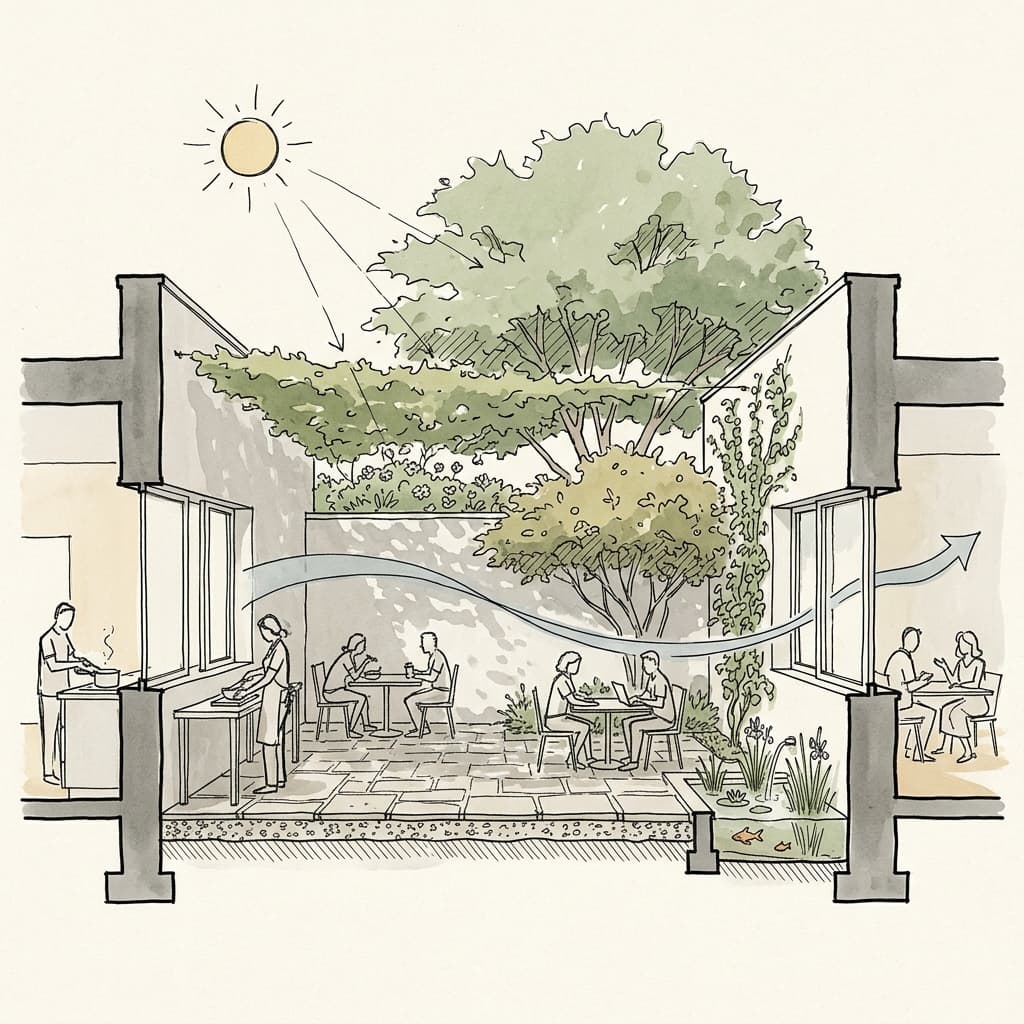
How do you cool a courtyard or a patio without air conditioning, when water runs short in summer? We start with shade, which stops the sun before it heats the courtyard. Then comes the ground: open soil throws back far less heat than asphalt. Water comes last, in small amounts, in a chosen spot.
This order may surprise, because we readily link coolness with water. The Córdoba patio, always held up as the example, is a case in point. Yet the measurements taken on site show that its coolness owes a great deal to shade.
In two deep patios of Córdoba, researchers recorded more than 8 °C less than outdoors in an ordinary summer, and nearly 14 °C at the peak of a heatwave. These gaps depend on precise conditions: a hot, dry climate, a narrow, tall courtyard the sun barely enters, thick walls that absorb the day’s heat and release it at night, daily watering. So they cannot be promised elsewhere. The researchers could not separate the share of water from that of shade, but one measurement says a lot: with a simple shade sail stretched over the patio, the gap went past 15 °C. Shade stops the sun before it heats the ground, and the watering, as it evaporates, adds to the effect.
Conversely, an oasis does not always cool. In Tolga, in the Ziban oases of Algeria, summer measurements found near-identical comfort inside the palm grove and in the neighbouring district: in extreme heat, the oasis brought almost nothing. It lacked dense shade, and neither the palms nor the water can replace it. A deep patio provides it through its very shape.
Someone still has to keep it alive. In Córdoba, the patio is a living tradition as much as a technique: the Fiesta de los Patios, inscribed in 2012 on UNESCO’s list of intangible cultural heritage, rewards each spring neighbours who water every day, renew dozens of pots and tend their patio all year for a few weeks of bloom. No specification provides for that daily care. Before drawing a courtyard, you therefore need to know who will water it and who will look after it.
In France, the oasis playgrounds of Paris follow the same logic: open ground, shade trees, materials that hold their coolness, and a water feature whose role is mostly playful and educational. More than 200 playgrounds have been transformed since 2017. We work in their wake: with POESAGES, we replaced the asphalt of a school playground in Savoie with three trees and some 300 m² of lawn, as we tell in “Unsealing a school playground”. In such a playground, water can stay modest, a small planted closed-circuit basin for instance, whose form is set by the children’s safety. It cools one corner of the playground, far less than the shade of a tree.
To design a courtyard in this spirit, you start with the sun: the narrower and taller a courtyard, the longer the shade stays in it, as in Córdoba. You also think of the air that crosses it and carries the heat away, the subject of our article “Cooling without air conditioning”. Then you plant a tree that will grow tall, with shrubs at its foot, and replace the asphalt with soil. Stone is kept for shaded spots, where it heats up less. Water comes last, ideally rainwater. During a drought, watering may be restricted, and harvested rainwater cannot be used just anyhow: those rules are checked locally, at project time. In your own courtyard, where does the shade fall at four o’clock on an August afternoon?
Guillaume Ciletti
Licensed Architect (HMONP) - Founder of LIBER.ARCHI