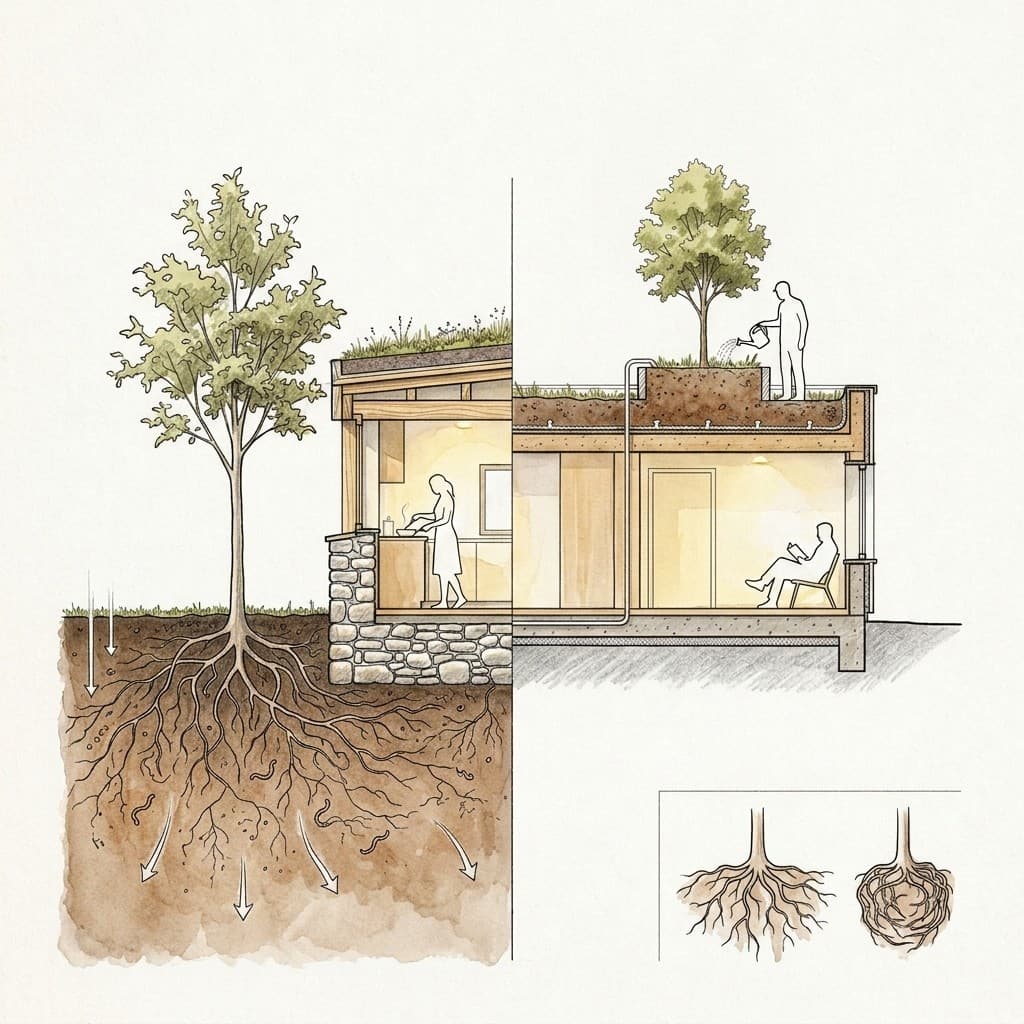
Under a tree planted in open ground, water sinks in, coolness settles, life moves through, with no pump and little care. Before sending plants up the building, look at what the soil already knows how to do.
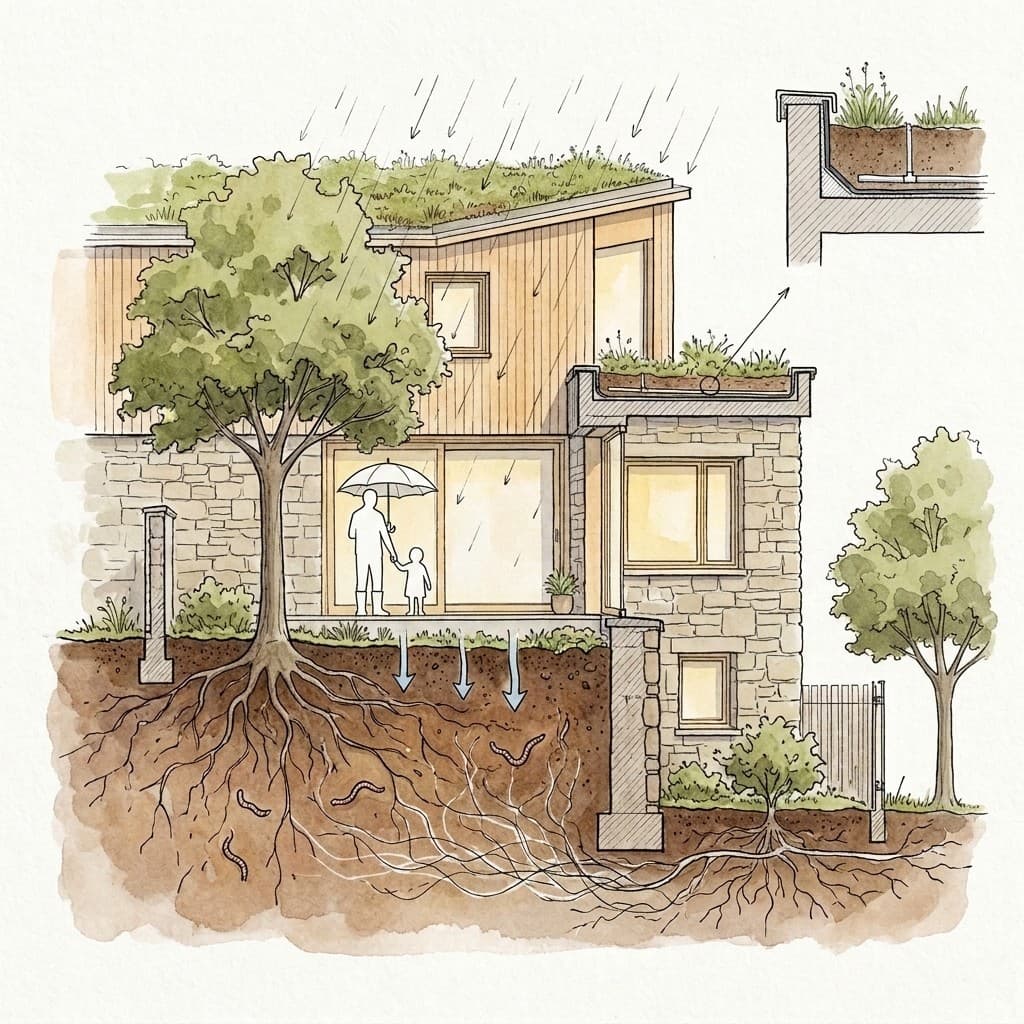
Is it better to plant in open ground or to green the building itself? To our mind, almost always in open ground. Planting in the soil that is already there is simpler, cheaper and healthier than rebuilding an artificial one on a slab or up a façade. A tree in open ground finds its own water, anchors itself, strikes up underground alliances with fungi and earthworms; the same tree in a planter will depend for life on an imported soil, a pump and a maintenance contract. One grows free. The other stays on a drip.
Living soil works. It drinks the rain instead of flushing it into overloaded networks; it cools the summer air through the water it holds and the shade of the trees it feeds; it shelters a discreet, considerable fauna, from earthworm to ground beetle. All for next to nothing. And it connects: a garden in real soil can be crossed, a hedgehog passes through, a seed travels, a root meets its neighbour’s. That is what an ecological corridor is: a path that living things actually use. No imported soil, however well designed, renders all of these services; at best it imitates a few, at the price of depth, structure and irrigation.
The most telling example we know stands in Paris, along the Petite Ceinture, the city’s old rail belt. La Ferme du Rail, by the Grand Huit practice, plants 1,800 m² around 833 m² of building, complemented by vegetable roofs: an orchard, a permaculture mound, a greenhouse-restaurant. The soil produces vegetables and jobs. Here the soil sets the programme, and the building was drawn around it; its vegetable roofs add to the open ground without replacing it.
Alongside it, the great planted buildings deserve credit. Stefano Boeri’s Bosco Verticale in Milan has shown for over a decade that a structure can carry trees high up and keep them alive. In Eindhoven, Trudo Vertical Forest carries the principle into social housing. In Sydney, One Central Park’s green wall shades the flats in summer. Yet none of these projects touches the ground. Everything is off the ground and watered for life; in Milan, rope-access gardeners prune the trees along the façades, upkeep the residents pay for every year. These feats leave the question of the soil wide open: they show that we know how to plant a building, and say nothing of the soil it covers.
Sometimes, though, there is no open ground to be had: a parking slab under the courtyard, a dense centre without a spare square metre, polluted soil that cannot be opened. Then yes, rebuilding a soil on the structure is legitimate, and at times it is the only purchase a site offers the living world. But it must be done with everything it entails: a real depth of soil, a structure sized to carry it, irrigation designed from the first sketch, and above all a caretaker named and budgeted before the first line is drawn. The hierarchy itself does not move: open ground first, rebuilt soil on a slab next, planters as a last resort. It is an order of priority, which does not prevent combining all three on one project.
Planning law, as it happens, is heading the same way: France’s drive to curb land take rewards de-sealing, that is, giving the ground back to the rain; and open-ground ratios are appearing in recent local plans. Thresholds vary and must be checked plan by plan, but the direction is clear: the soil is becoming a part of the project in its own right, like the structure or the envelope.
So before drawing a green roof, one simple question: what have we done with the ground? If a square metre remains to be unsealed, planted, connected, start there. A green roof goes on in a season; a tree takes a generation to give its shade. All the more reason to plant it first.
Guillaume Ciletti
Licensed Architect (HMONP) - Founder of LIBER.ARCHI