At the bottom of my garden, a pond dug in 2005 has kept its water clear in every season, with no chlorine and no UV lamp. What keeps it clear grows, flowers and sinks its roots into the water. What that tells, and does not tell, anyone dreaming of a natural swimming pool.
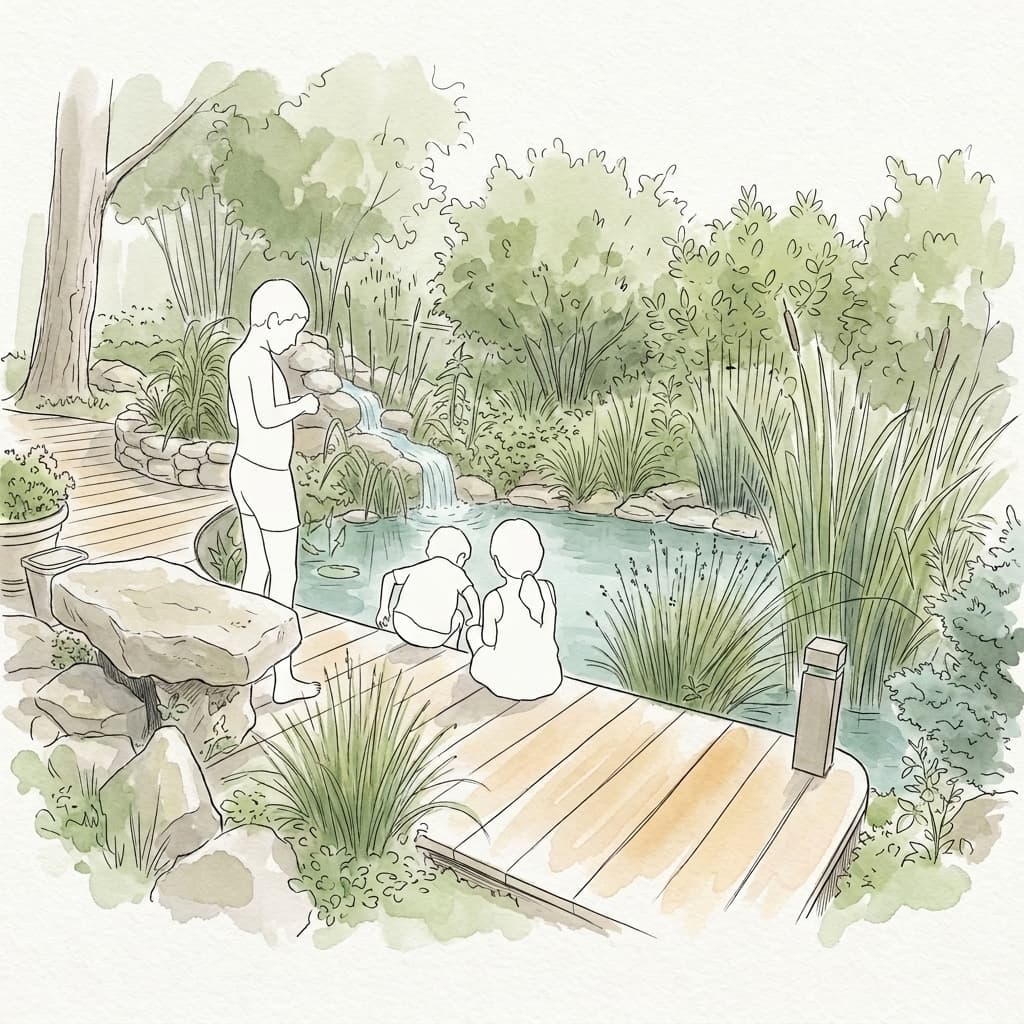
How does water stay clear without chlorine? Because an ecosystem does the work. The plants, with the they root in, consume the nutrients algae would need to bloom; you don’t sterilise, you balance. I know it from a pond, not a pool: mine measures about eight square metres, thirty centimetres to a metre deep, and nobody swims in it. Since 2005, the water has been clear in every season. Twenty years of watching do not replace a calculation, but they show the principle holds.
The workforce, in this pond, has names: Iris pseudacorus, Caltha palustris, Pontederia lanceolata, Cyperus involucratus, Equisetum scirpoides, Potamogeton lucens, waterlilies; some arrived on their own, as stowaways. Their roots plunge into the water and draw out its nutrients; algae find less to feed on, and struggle to settle. Below the surface, rocks shelter the micro-fauna that does the rest.
This living work still needs a little technique. A closed-circuit pump lifts the water to a raised basin, from which it falls back into the pond as a thin sheet of water, oxygenating it and keeping it moving. It sterilises nothing; it keeps the water moving.
Half a day a year is enough for maintenance: pulling out vegetation, to leave the plants room to grow. Their growth is what cleans the water. You harvest the filter, since the filter, here, is the plants. What this ornamental pond shows, at least, is this: the biological balance has lasted two decades, with no product added.
It welcomes company, too. A chlorinated pool offers only sterile water, where small wildlife comes to drink at its own risk; here you see dragonflies, self-sown plants, amphibian spawn along the bank. Goldfish live there too. In a pond designed first for amphibians, their presence would be open to question, since they tend to eat the spawn.
A natural swimming pool transposes the principle to bathing scale: a swimming zone, and beside it a planted regeneration zone doing what my pond does across its whole surface. We have never built one: what we bring here is the eye of a designer and landscaper, not a site report.
Scale changes everything. Swimmers bring nutrients an ornamental pond never sees, and clear water is not yet water fit to swim in. The more you expect the water to keep a constant quality, the more the whole needs sizing: the share of planted area against swimming area, the profile of the banks. And before the first line is drawn, one question: who will maintain it, how often, on what budget?
Living water, too, should be described in advance. It is amber, not turquoise; it has its spring algae while the plants get going again; it invites guests you did not ask for. Announced, all of this becomes the charm of the place; discovered, a defect. Whoever wants shower-gel water, smooth and blue, should know it before digging.
On the legal side, the status of natural swimming ponds is unclear: a ministerial answer of 2023 places them outside the safety rules for private pools, but it does not have the force of law. The formalities, for their part, depend on the size of the project and on the local authority; so ask at the town hall before you dig. And even where nothing requires it, design for young children’s safety, out of plain good sense.
After that, you plant. For twenty summers I have watched my pond at work: the falling water sings, the waterlilies open, the water stays clear.
Guillaume Ciletti
Licensed Architect (HMONP) - Founder of LIBER.ARCHI