From above, two green roofs look alike. Stand on them and the difference is obvious: one is a blanket, thin, uniform, quiet; the other has hollows, mounds, a flat stone, a puddle barely worth the name where a bird lands. They are not the same roof.
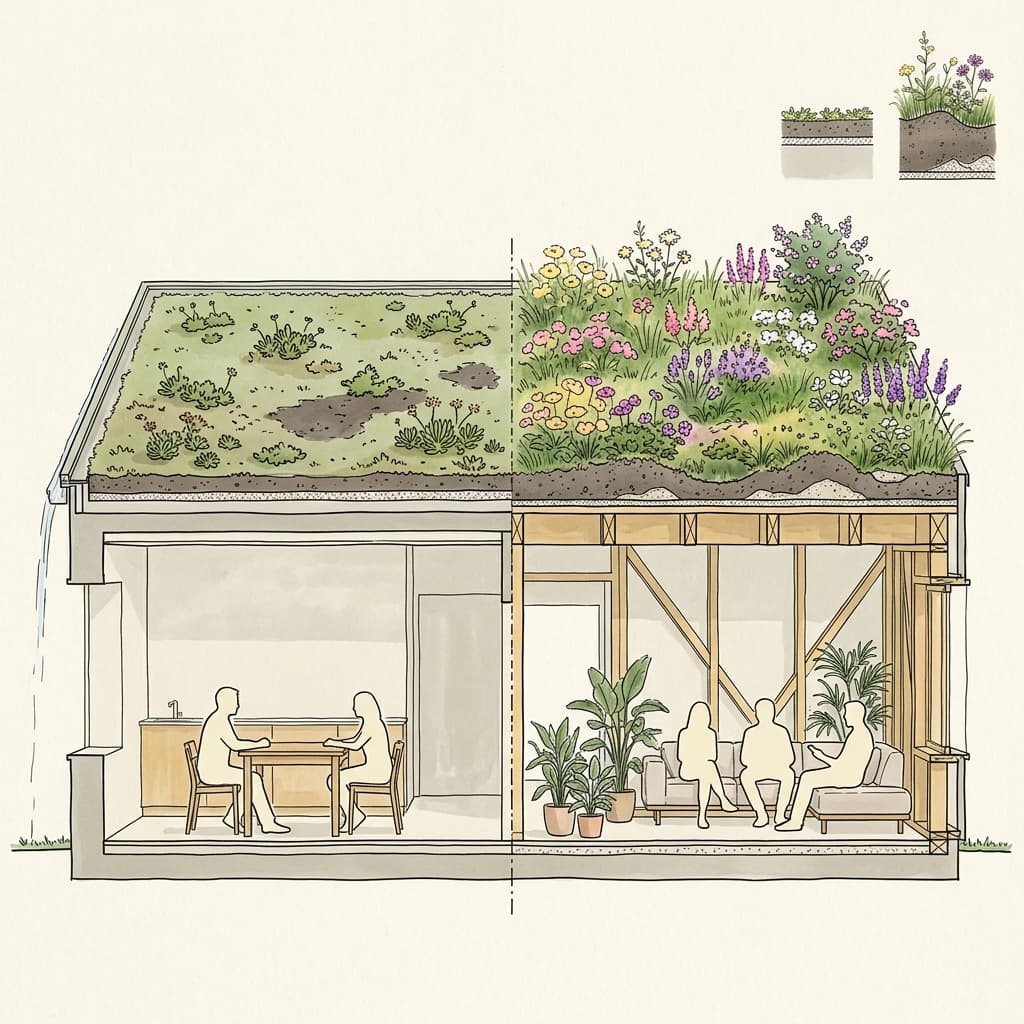
Does a green roof really serve biodiversity? Not always: a sedum mat, however green it photographs, is not an ecosystem. To hold it in place takes only a little , the lightweight soil spread on roofs, and a few succulents of the stonecrop family, which flower mostly in early summer. As for relief, there is none. A roof that is truly alive reads like a soil: depths that vary, hollows that hold water, refuges where something can hide. But it is heavier: before drawing it, you need to know whether the roof can carry it.
The sedum mat has a real merit: it holds back a little rainwater, insulates a little in summer, greens an image. It even hosts mosses, lichens and dry-ground species. But laid as a thin, continuous layer, it shelters few species. A ground beetle looking for the shade of a stone finds none; a solitary bee that digs into warm sand has no sand to dig into; a bird watching for a puddle after the rain finds only flat, dripping foliage, nothing to land on. The GROOVES study, run from 2017 to 2019 on thirty-six roofs around Paris, bears this out: sedum roofs held fewer plants and fewer invertebrates than roofs with deeper soil.
What changes everything is relief. A roof designed for the living varies its substrate depth, thin in places, deep in others. That variation alone grows different species zone by zone, and the same study recommends exactly this, varying depths across a single roof: dry-ground plants on the mounds, thirstier ones in the hollows. It carries materials that do nothing for waterproofing and everything for shelter: a pile of dead wood, a bed of sand, stones scattered without order. And, where the waterproofing and structure allow, a puddle a few centimetres deep, drying out in summer and filling again in winter like a small seasonal pond. Nothing spectacular.
The law already leans this way. French building law requires, on a large share of new non-residential buildings, a green roof or a renewable-energy system such as solar panels: 40% of the roof since 1 July 2026, 50% from 1 July 2027. The text asks for more than green: it wants a system that favours “the preservation and reconquest of biodiversity”. A sedum mat may respect the letter of that phrase; a roof with relief serves its spirit. The exact thresholds, scope and dates must be checked project by project, never taken on faith.
A green roof does not replace open ground, as we explained in “Soil first”: it adds to it, or takes over where the soil is missing. But a rebuilt soil calls for a structure to carry it, a waterproof layer, watering at times, and someone named to look after it. It may as well be worth something, then. That is why the choice is made at sketch stage, when the slab or the frame is planned to carry layers of soil of varying depth. On an existing roof, what the frame or the slab can still carry often decides for us, and the result is a light mat.
On the next roof plan, let us draw a hollow, a mound and a flat stone first, if the structure can carry them. A mat unrolls. A habitat, by contrast, is drawn.
Guillaume Ciletti
Licensed Architect (HMONP) - Founder of LIBER.ARCHI