A patch of water without chlorine, however small, draws life into a garden, and a pond is its richest form. As for mosquitoes, according to a study by Cerema, a house’s rainwater tank, no bigger than a washtub, produced as many as a 1,600 m² planted basin.
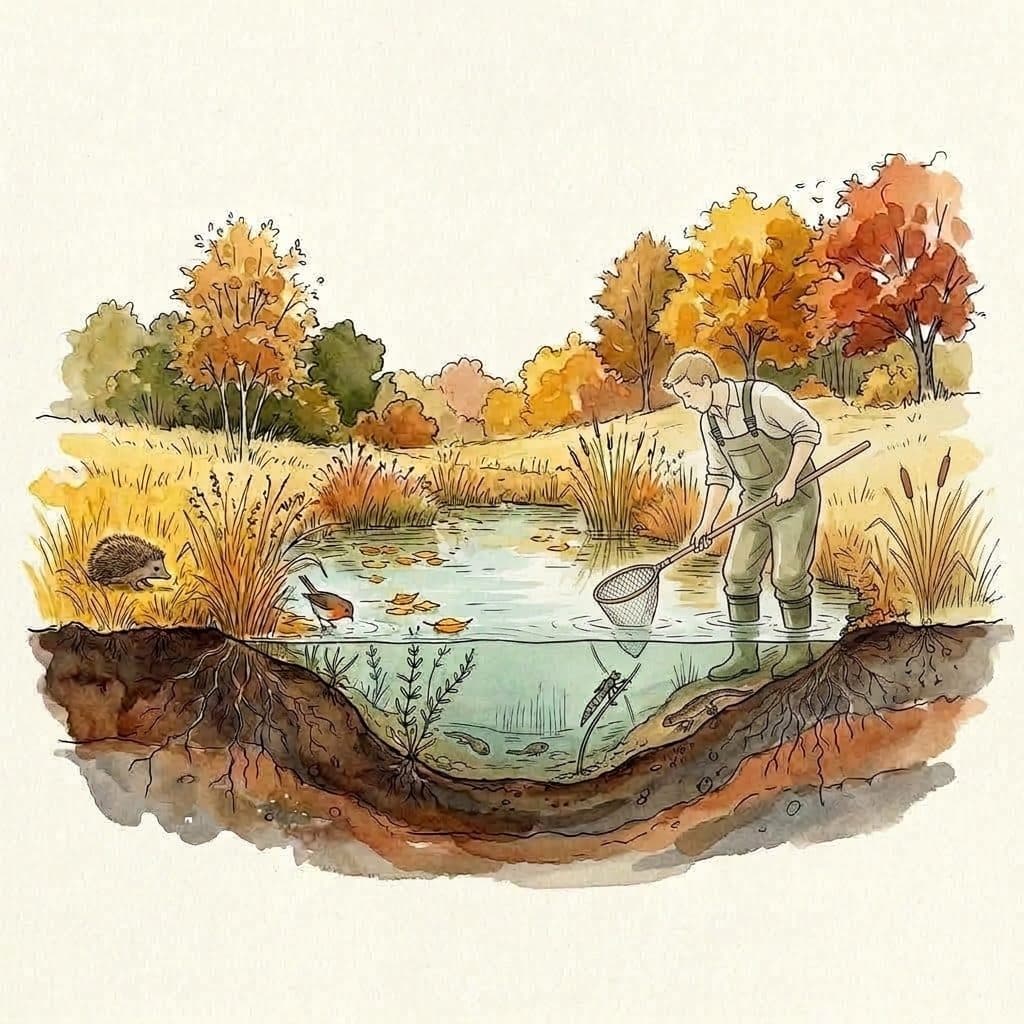
If we could recommend only one thing for a garden’s biodiversity, it would be water without chlorine, even a little. Its richest form is the pond: a shallow stretch of water with gently sloping banks, filled by the rain, with no pump and no filter. A dragonfly settles on a rush, and one spring evening, perhaps, someone starts singing in the water.
Why water? Because a pond offers several habitats in one. The damp bank, the fringe of plants standing with their feet wet, the surface where creatures land, the bottom where they hide: each layer has its residents. Dragonfly larvae grow up underwater before taking wing; a garden without water will never see them emerge.
Hence a simple hierarchy. A chlorinated pool serves swimmers alone. A natural swimming pond shares its water with the creatures of its planted zone. In a pond, all the water goes to plants and animals. This order is in line with our article “Soil first”: without a liner, the bottom of a pond is living soil, simply soaked with water.
The pool I dug at the bottom of my garden in 2005 shows that even imperfect water draws life. A pump circulates the water, a liner keeps it watertight, goldfish live in it. Plants have still settled in on their own, and a frog came to live there: an enormous noise for its size, an instant atmosphere, though not everyone can stand it. If you dig for these small creatures, leave the fish out: according to karch, the Swiss centre for amphibian conservation, most fish eat amphibian eggs and tadpoles, and some species, such as the common frog, suffer particularly.
What about mosquitoes? Their larvae grow in still water, and a pond has plenty of it. Yet according to a report by Cerema, the French state’s public expertise agency, a house’s rainwater tank, no bigger than a washtub (0.32 m²), produced as many adult mosquitoes at the height of summer 2023 as a planted basin of 1,600 m². The study followed six roadside basins in Lorraine: in those that hold water all year round, larvae remain very rare, and it puts this down first to the other small creatures in the water, which eat them. Around the house, the tiger mosquito makes do with even less: according to the Île-de-France regional health agency, a few millimetres of water are enough for its larvae. Empty saucers and buckets regularly, unblock the gutters, and leave the pond to its residents.
With children, the risk exists whatever the water. According to the French Ministry of Sport, a young child is at risk in as little as 20 centimetres of water. The law requiring a barrier or an alarm applies to in-ground swimming pools; according to the French Ministry of Ecology, it does not cover ponds or ornamental pools. Owners are nonetheless liable for what happens on their property, and the rules of a housing estate or a co-ownership may require more. A gentle bank helps a child climb out; if young children use the garden, we recommend a fence, and nothing replaces watching over them.
Before digging, a visit to the town hall is needed. According to Article 92 of the departmental health regulations of Savoie, reproduced word for word in Haute-Savoie*, creating a pond requires the mayor’s authorisation. It is prohibited within 35 metres of springs, boreholes and wells, and of structures that carry or store water intended for drinking or for watering market-garden crops; and within 50 metres of homes occupied by third parties, leisure areas and premises open to the public. Each French département has its own regulations: the town hall will tell you what applies where you live.
The model for these regulations dates from 1978 and targets stagnant water, in the name of public health. Yet in Cerema’s study, the permanent water of planted basins held very few larvae. According to France’s national nature protection society (SNPN), between a third and a half of French ponds have disappeared since 1950, an old figure; a national Ponds Action Plan launched in 2025 aims to restore or create 30,000 of them by 2030 and to lift the regulatory obstacles to their preservation. We find it a pity that small gardens, where the neighbours’ house is often less than 50 metres away, should go without. Then there is the frogs’ chorus, which gives a pond its charm in spring and can become a grievance for anyone who hears it at night through an open window. The courts have already ordered a pond to be filled in after a dispute between neighbours.
After that, a spade and some patience. Give the banks a gentle slope: small creatures can get in and out, and plants can settle in tiers. A stump or a few stones at the edge add shelter. The soil decides what comes next: clay holds water, sandy or stony ground lets it drain away. Depending on the ground, the pond will keep its water all year, drop in summer, or need a watertight lining to hold it. Before you start, dig a small test hole, fill it and watch how long the water stays. Then let the rain fill the hollow, and wait: the first residents arrive uninvited.
* Regulations consulted on 6 October 2026, in the version published online by the Auvergne-Rhône-Alpes regional health agency (2017). They may have changed since: your town hall will tell you what applies.
Guillaume Ciletti
Licensed Architect (HMONP) - Founder of LIBER.ARCHI